Stadium 03 · Mexico City
Estadio Azteca
Cut into volcanic rock in the south of Mexico City, the Azteca is the opposite of a stadium assembled from stands. It is one continuous crater, and from the top row the pitch looks like something at the bottom of a well.
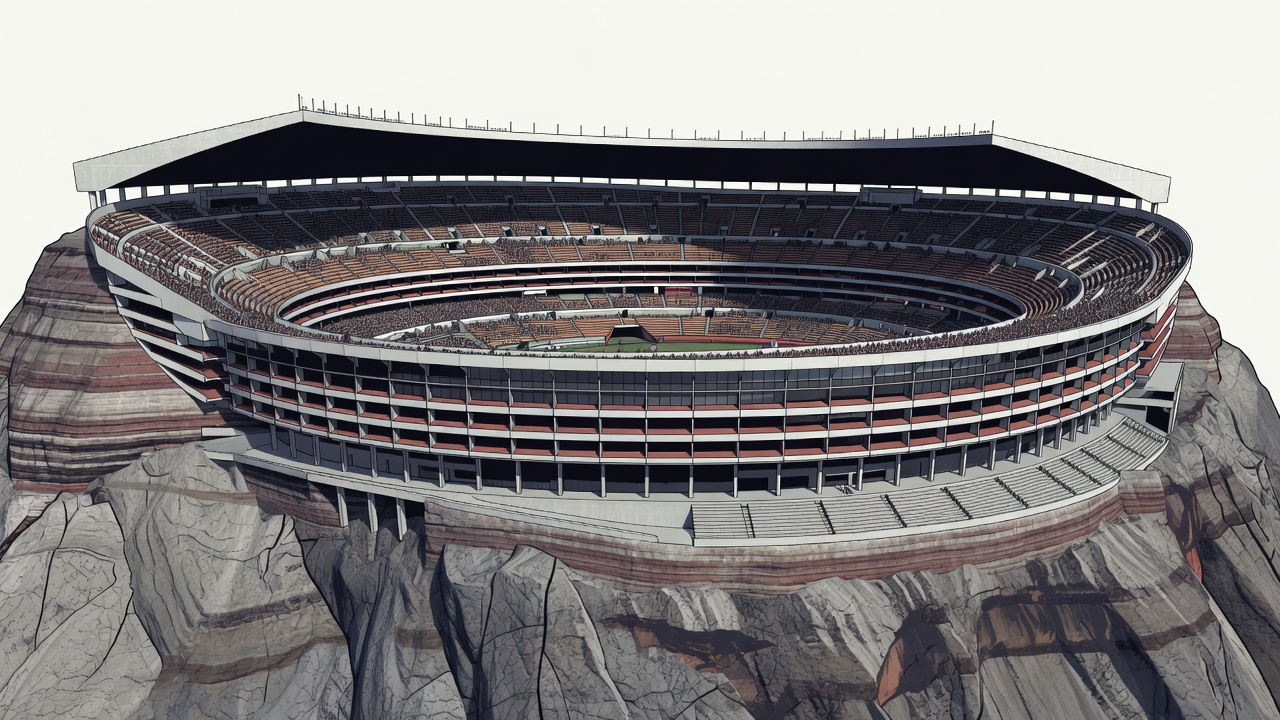
A crater, not a set of stands
The Azteca opened in 1966 in the Santa Úrsula area of southern Mexico City, on the hardened lava field that covers much of that part of the valley. It was designed by the Mexican architects Pedro Ramírez Vázquez and Rafael Mijares, and the central move was excavation: rather than building the whole bowl upwards, they dug the lower tier down into the rock. The rock does the structural work that concrete would otherwise have to do, and the stadium presents a lower, heavier profile to the street than its interior volume suggests.
What you get inside is continuity. The seating runs as an unbroken ring around the pitch, with no gaps at the corners and no stand that behaves as a separate building. Every part of the crowd is acoustically connected to every other part. Sound does not escape at the junctions, because there are no junctions.
Rake: the most vertical crowd in these five grounds
The Azteca is steep, and steepness is the reason it feels enormous from within. The upper tier climbs at an angle that stacks spectators close to above one another, so a very large crowd occupies a comparatively small horizontal footprint. Two things follow.
The first is distance. A steep deck brings the back row much nearer the pitch, measured along the line of sight, than a shallow deck of the same capacity would. Sound arrives with less travel and less loss, and the crowd reads the pitch as a surface rather than a distant band.
The second is the wall effect. A near-vertical bank of people is a large, mostly hard, partly absorbent surface facing the field. It reflects the noise generated lower down and, crucially, returns it inwards. In a shallow bowl the same crowd is spread flat and much of what it produces radiates upwards into the sky.
The ring of boxes, and what it costs
Between the tiers runs a ring of private boxes — a feature the Azteca had long before it became common practice. Commercially and historically it is significant. Acoustically it is a horizontal break: a glazed, soft-furnished band interrupting what would otherwise be a continuous face of standing and seated spectators, and a section of the bowl that contributes far less to the sound than the decks above and below.
This is the recurring trade-off in stadium design and it has no clean answer. Boxes fund the building. They also replace the loudest possible surface with one of the quietest, at mid-height, all the way round. The Azteca is loud because the tiers above and below the ring are so large and so steep that they overwhelm the interruption.
Roof, and a field open to the sky
A cantilevered roof covers a substantial part of the upper seating and leaves the pitch open. That is the standard compromise for grass, and it produces the familiar Azteca condition: spectators under cover, play in full sun or full rain, and a reflective ceiling over the highest and steepest part of the crowd — the part best placed to send sound back down.
Altitude, and what can honestly be said about it
Mexico City sits at roughly 2,200 metres above sea level, and the Azteca with it. The well-documented consequence is physiological: visiting teams unaccustomed to the altitude tire faster, and the ball travels differently through thinner air. Federations and clubs plan acclimatisation around it, and it has been part of the stadium's reputation since the 1970 World Cup.
What should not be claimed is a precise acoustic figure. Air density does affect how sound carries, but the audible character of a full Azteca owes far more to its geometry — continuous ring, extreme rake, roofed upper deck, enormous capacity — than to anything reliably attributable to elevation. Where a design guide cannot separate two causes, it is better to say so than to invent a number.
History that shaped the shape
The Azteca hosted the World Cup finals of 1970 and 1986, the first stadium to stage two, and it has staged Olympic football and gridiron as well as domestic football. Capacity has changed with successive refurbishments: the original figure was above 100,000 and later reconfigurations reduced it, as safety standards, seat widths and access requirements advanced everywhere. For the current figure, consult the stadium operator's published information.
Where to sit
Low behind a goal you get the crater looming above and almost no read of the game's shape. Mid-height on the long sides is the honest compromise. High in the upper tier, under the roof, you get the full effect the building was designed around: the whole ring visible at once, the pitch far below, and the sound of a large crowd arriving from a surface rather than a direction.
Estadio Azteca at a glance
- Opened
- 1966, in the Santa Úrsula area of southern Mexico City.
- Architects
- Pedro Ramírez Vázquez and Rafael Mijares.
- Configuration
- Continuous sunken bowl, lower tier excavated into lava rock, no open corners.
- Rake
- Very steep tiers separated by a ring of private boxes.
- Roof
- Cantilevered cover over much of the upper deck; pitch open.
- Altitude
- Roughly 2,200 metres above sea level, with well-documented effects on players.
- Tournament history
- Host of the 1970 and 1986 World Cup finals.